Harold Innis and why friction can be empowering
Typically, consumer products are advertised as giving you more control: more options, more efficiency, and instantaneous reward. But lately, some products have started to promise the opposite: fewer options, more friction, and delayed gratification.
A few examples: The Brick, a small device, will turn your iPhone into a call-and-text dumbphone. In Amsterdam, the Offline Club hosts almost daily phone-free events, aiming for a kind of Soho Club of Luddism. The FreeWrite (375 EUR) is a digital typewriter that lets you do nothing but write. As I write this, my computer is running Freedom, a paid domain-blocking app that is actively and obstinately stopping me from accessing over 100 domains. (There is no override.)
It is no accident that two of these products play with the concept of “freedom” in their name. There is a latent theory of power in this wave of self-limiting products. This theory essentially has two main claims:
- Problem: As the internet empowers you in one way, it disempowers you in another. Even as the internet and smartphones put the world at your fingertips, many people feel they have less agency over their time, not more.
- Solution: Putting limits on our digital agency can, ironically, empower us to do more of what we really want.
This is an intuitive and compelling theory, but it is also somewhat simplistic. Why does the universal accessibility of information paralyze us? What kind of “limits” are we talking about? In an attempt to better understand this modern paradox, it might actually help to look back in time.
Two years ago, while browsing a used-book store in Manchester, I came across an out-of-print book of media theory from the 1970s: William Kuhns’ Post-Industrial Prophets. It’s a survey of critical philosophical reflection about the information age, revolving around the question “What has gone wrong?” It was published two decades before the internet was invented, and this very datedness was intriguing: if anything in this book stood the test of time, it must be a very strong idea.
Indeed, one philosopher from Prophets struck me as the most prophetic: Harold Adam Innis.
Innis was a technology historian who believed changes in dominant communication media drove the course of political history. Writing in the mid-20th century, Innis developed a theory in which every technology has either a spatial bias or a temporal bias.
- A spatially-biased technology can influence vast areas in space, as with radio broadcasting or the telegraph, but is ephemeral. The internet is the ultimate example of this, optimized to make geography irrelevant to the flow of information.
- A temporally-biased medium has a limited spatial reach, but a lasting legacy. For example, take a stone sculpture that may only be visible in a small geographic area, but has an influence that can last for centuries, even millenia. It may also exist immaterially, for example, a local legend that shapes a community’s consciousness for generations, even as it is unknown two villages away.
Innis argued that the most successful cultures balance the two biases, with Ancient Greece as his favorite example. And he saw such a space/time balance as key to cultural vitality. Innis worried that the 20th-century West had begun to over-rely on communications technologies that were spatially powerful, like newspaper and radio, at the cost of traditions that lasted over time. He diagnosed Western culture as having an “obsession with the moment.”
He also thought this obsession with the ephemeral weakened human agency: “The contemporary attitude leads to the discouragement of all exercise of the will,” he wrote. “The essence of living in the moment and for the moment is to banish all individual continuity.” What would he say about 2025?
If we extrapolate Innis’s theory to our present challenges, it might go something like this: The modern world is afflicted by a disproportionate spatial bias. Most people today carry in their pockets a device that can access information from anywhere almost instantly. But as we transcend distance, we lose access to more localized forms of communication and cultural creation that are vital to the long-term thriving of human cultures. We struggle to concentrate deeply, stick to plans, and control our attention. Our temporal power has been eroded, and with it, our ability to enact our will.
However, Innis’ focus on space also points to a new kind of solution: If we want to re-gain our power to act with intention across time, spatial boundaries are a tool we can use.
What would that look like? Well, one example is the aforementioned product, Brick. In an interview with Fast Company, one of the company’s founders says: “I love the internet of the 1990s: You boot up the computer and, as soon as you walk away, you aren’t online anymore.”
The fact that nostalgia for the “computer room” has become so common reflects a key intuition: We understand that to thrive emotionally, creatively, and intellectually, it can help to have spatial heterogeneity, or different places for different things: A place to sleep, a place to work, a place to read, a place to talk.
Even as the smartphone seduces us with visions of omnipotence, we can recall that as recently as the 1990s, the internet was a place you could “walk away” from. And as the adage goes: when one door closes, another one opens. Where spatial power stops, other forms of power begin…
What this can look like in our homes, organizations, cities, and everyday lives is something we will continue to explore.
This post written by: Eduard
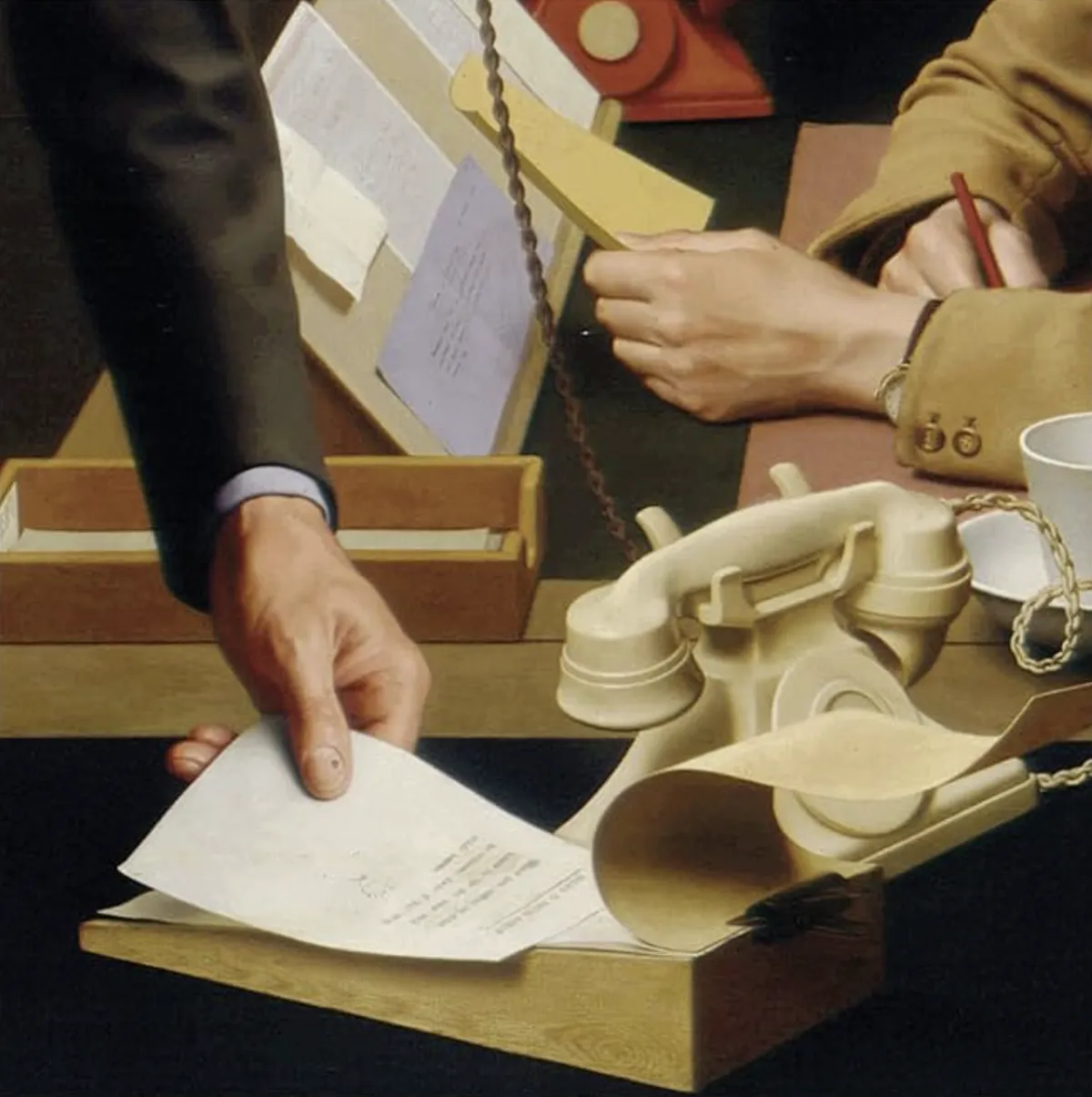
Illustration credit: Meredith Frampton, "Sir Ernest Gowers, KCB, KBE, Senior Regional Commissioner for London, Lt Col AJ Child, OBE, MC, Director of Operations and Intelligence, and KAL Parker, Deputy Chief Administrative Officer, in the London Regional Civil Defence Control Room 1943" (link), as excerpted on the cover of the 2016 Penguin Modern Classics edition of Vladimir Nabokov's 'Pale Fire'.